The First Lesson of Arriving in Another World: Recognize Reality and Manage Resources
When you open your eyes, the ceiling above is not the familiar one but a glowing magic circle or an unfamiliar starry sky. In the surge of adrenaline, don’t rush to shout that you are the chosen one. Reality is often much crueler than the reincarnation process in anime. Many transmigrators fall at the first stop, not in a monster forest, but from starvation or being burned as a heretic. The core logic of survival is very straightforward: immediately establish a survival baseline. Here are five rules that must be etched into your DNA, sorted by priority, directly determining whether you survive for days or years.
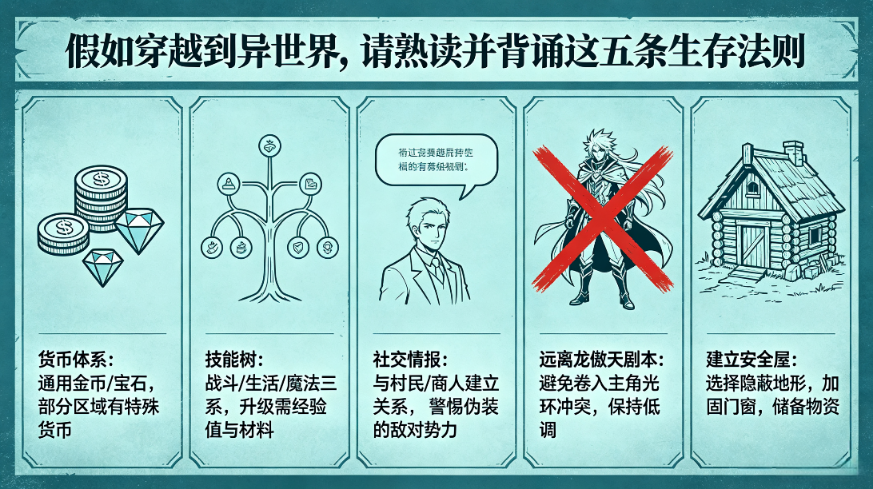
Rule 1: Don’t rush to find the hero; first understand the currency system
Most otherworld openings directly hand you a pile of gold coins, but these might not even exchange for a piece of black bread in the grassroots market. Different worlds have completely different economic anchors; some settle with magic crystals, others with grain or cloth, and some even circulate faith points or contract points. Understanding the currency system is an absolute prerequisite for survival. The first step you need to take is to observe market transactions and record the exchange rates of three daily commodities. If you encounter locals who have money but can’t buy basic herbs, it means your currency is hard currency; at this point, hoarding materials is wiser than rushing to level up. If the local area only accepts specific currencies, immediately give up illusions, master basic handicraft or gathering skills, and use barter to maintain minimum caloric intake. Don’t believe the nonsense that a prophesied hero will give out money; the operation of the economic system only depends on supply and demand, not a script. Establish your own material exchange table, record price fluctuations daily, and find the most cost-effective combination of survival materials.
Rule 2: Choosing the wrong skill tree can be fatal; prioritize survival-oriented skills
When the system panel pops up, skills with names like “Annihilation Dragon Knight Forbidden Spell” are indeed tempting, but the mana consumption and physical load are real. A single high-level spell release might directly cause internal bleeding or attract high-level predators from miles around. Survival-oriented skills are the foundation for prolonging life. Prioritize grabbing mana recovery, basic medical treatment, environmental perception, and language comprehension. Language skills help you avoid religious taboos and political minefields; environmental perception can give early warnings of poisonous miasma and traps. Invest skill points in defense and recovery, and learn to produce clean water and hemostatic dressings at the lowest cost. In the real world, those who survive to tomorrow rely not on burst power but on endurance. Don’t learn flashy but mana-draining skills for面子; your body simply can’t withstand the backlash. Do basic physical training daily, record skill cooldowns, and ensure you can stably trigger life-saving measures in emergencies.
Socializing and Intelligence: The Key to Surviving in Unfamiliar Rules
The social structure of another world is often marked by strong hierarchy and mysticism. Rushing to integrate or trying to be a savior will only make you a pawn in the game of various forces. An intelligence network can determine your life and death more than combat power. You need to quickly draw a local relationship map, figuring out who controls the water source, who controls the mineral veins, and who secretly manipulates the church. Information asymmetry is the biggest killer in another world; mastering core intelligence allows you to avoid deadly traps.
Rule 3: Keeping silent is a virtue, but learning to ask questions can save your life
When you first arrive, never blurt out modern scientific knowledge or historical spoilers. In a society dominated by superstition or magic, your common sense will be directly labeled as heresy. Stay silent and observe, using a combination of closed and open questions to extract information. For example, ask about the faction divisions indicated by road signs, or the historical origins behind festival sacrifices. Judge the level of information blockade by the other person’s micro-expressions and word choices. Building trust takes time; first use small favors or basic medical knowledge to exchange for basic intelligence, then gradually go deeper. Don’t try to change the world; first understand how it operates. The skill of questioning lies in packaging sensitive issues as a curious learner’s inquiry, making locals feel you respect their culture rather than challenge their authority. Establish your own intelligence notebook, review conversation details daily, and extract key faction movements.
Rule 4: Stay away from power fantasy scripts and beware of causality weapons
In plots, those who start off embroiled in throne struggles, racial wars, or demon lord campaigns have a very low probability of surviving three episodes. Causality weapons refer to settings that can forcibly change the direction of reality, such as sure-hit curses, fate bonds, or children of luck. Once drawn into such a vortex, your life and death are no longer under your control. Cutting off causal entanglement is the core strategy. When someone forcibly tries to recruit you, use vague statements to stall for time and find an escape route. Do not accept any invitations with strong emotional binding or contractual nature. Maintain economic independence and social distance, making yourself a dispensable yet useful peripheral character. When all forces consider you irrelevant, you can safely accumulate resources. Regularly clean up your social circle, eliminating emotionally unstable or overly ambitious partners, and maintain a stable lifestyle.
Long-term Survival Strategy: Turn Another World into Daily Life
Surviving the early stage is just the first step; long-term security comes from systematic life reconstruction. Another world is not a playground but a survival space that requires continuous effort to maintain. Shift your focus from how to become stronger to how to live stably. Routine management provides more security than explosive growth.
Rule 5: Establish a safe house and maintain localization adaptation
The risk of a nomadic lifestyle is too high; you must have a fixed stronghold that you can evacuate from at any time. Location selection must consider terrain, defense, water source, distance, and concealment. Use local materials to reinforce doors and windows and set up simple alarm devices. Localization does not mean giving up yourself but learning to solve problems in the local way. Learn local crop rotation, master basic construction structures, and even imitate local clothing styles to reduce your profile. Adapting to the environment requires compromise, but the bottom line is retaining core cognition and emergency evacuation plans. Regularly inventory material reserves each year and update the safe house’s fortifications. Treat another world as a long-term project rather than a game to beat. A stable routine is the best weapon against unknown fears. Develop a detailed weekly plan, allocate time for gathering, patrolling, repair, and rest, turning survival into a predictable routine.
Transmigration is not a cheat code but an intense survival simulation. The core logic of these five rules is very clear: resource management lays the foundation, skill selection ensures endurance, intelligence and social interaction avoid sharp edges, cutting off causality seeks stability, and localization aims for long-term development. Don’t fantasize about becoming a savior; being able to safely survive the first winter and establish a stable food and energy source already surpasses 90% of transmigrators. It is recommended to systematically learn basic first aid, wilderness survival, and basic mechanical principles before departure; these modern knowledge often translates into powerful practical skills in another world. Grounding fantasies and refining survival is the most rational attitude toward facing an unknown world. Regularly review survival status, adjust strategies, and maintain flexible adaptability to stand firm in unfamiliar rules.